Marketing departments run more concurrent work than almost any other function in a business. Campaign briefs, creative reviews, media buys, landing page builds, email sequences, and reporting cycles all move at different speeds and depend on different people. monday.com for marketing teams was built to hold that complexity in one place, giving managers a single source of truth for what is planned, what is in progress, and what is blocked. The platform works well. The gap most organizations still face is that the information sits behind a login, and the people who need it most are rarely the people refreshing a browser tab.
This article covers what campaign visibility actually means in practice, where it breaks down, how to structure boards so they communicate clearly, and how putting live monday.com views onto office screens closes the last gap between data and decision making.
What Campaign Visibility Means in a Marketing Department
Visibility is not the same as access. Every marketer in your team probably has a monday.com license. Very few of them open every board that touches their work.
Real visibility means four things are obvious without anyone asking:
- What is live right now and how it is performing
- What is due this week and who owns it
- What is stuck and why
- How current output compares to the quarterly plan
When those four answers require a Slack message or a status meeting, the department is spending coordination time it could spend on execution.
Why Visibility Breaks Down Even with Good Software
Most marketing teams adopt a work management platform, configure it carefully, and then watch adoption drift within two quarters. The causes are consistent across organizations.
Information lives one click too deep
A campaign board with twelve columns and forty items is useful to the person who built it. To a designer checking whether a brief is approved, it is friction. People stop opening boards they cannot read in five seconds.
Status updates become a reporting task
When the only way leadership sees progress is a manually assembled weekly deck, a project manager spends hours rebuilding information that already exists in the system.
Cross-functional stakeholders never log in
Sales, product, customer success, and executives all care about campaign timing. Almost none of them are going to maintain a habit of checking a marketing board. They ask instead, and someone in marketing answers.
Remote and hybrid schedules fragment awareness
Hallway awareness used to carry a surprising amount of coordination. Distributed teams lose it, and nothing automatically replaces it.
The Operational Cost of Low Visibility
These are not abstract problems. They show up in measurable ways.
Duplicated work. Two people build similar assets because neither could see the other request.
Late launches. A dependency slips quietly for a week because nobody outside the owner saw the delay.
Slower approvals. Creative sits in review because the reviewer did not know it was waiting.
Meeting inflation. Status meetings expand to fill the information gap. A team of fifteen running two extra thirty-minute syncs a week loses roughly sixty five hours a quarter to reporting that a dashboard could handle.
Weak accountability. When performance data is visible only in a monthly review, corrective action happens a month late.
Making monday.com for Marketing Teams Visible Where Work Happens
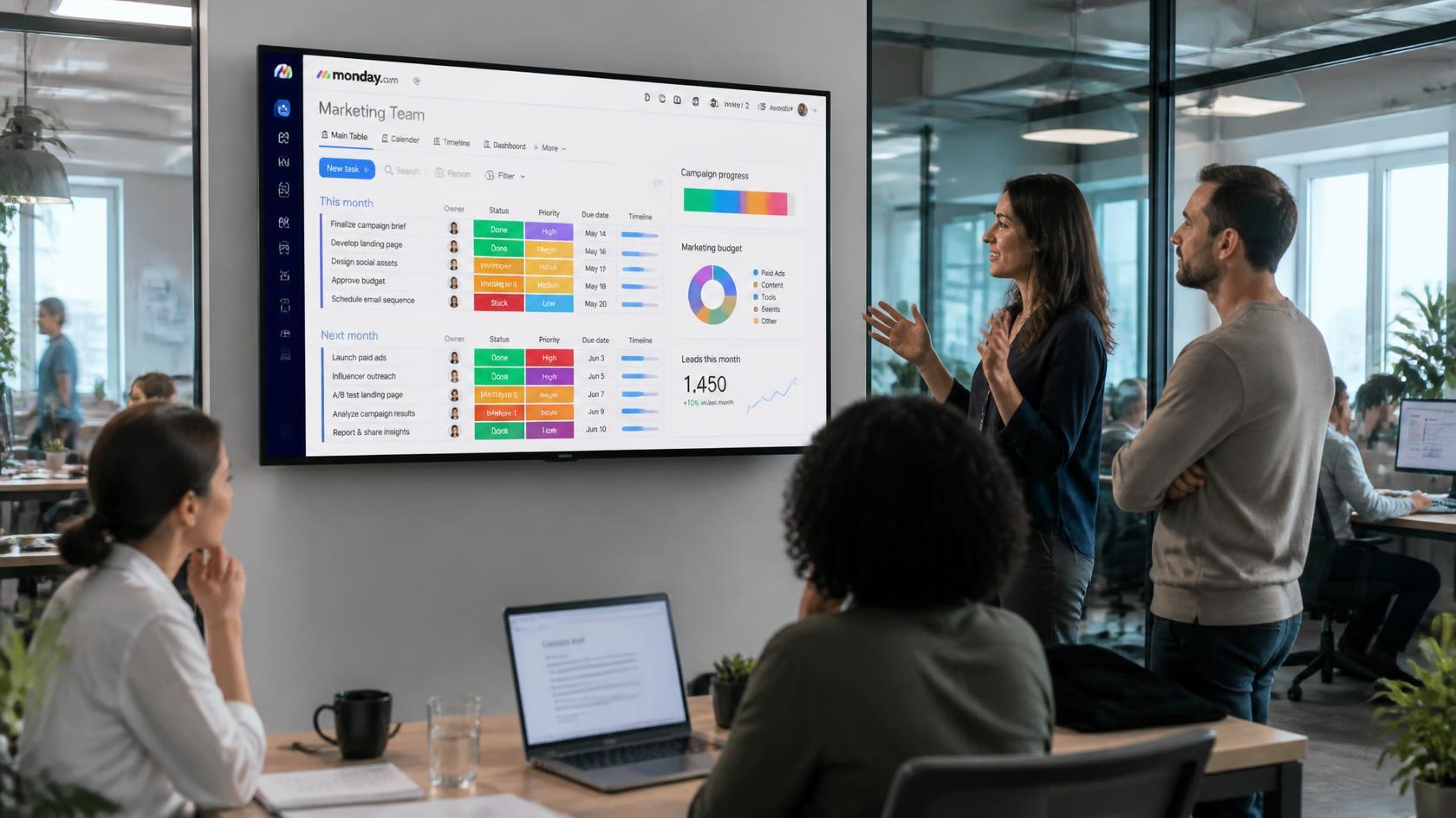
The practical fix is to move selected monday.com views out of the browser and onto screens in the spaces your marketing department already occupies. Board views, timeline views, and dashboard widgets are all readable at distance when they are configured for it.
RocketScreens connects to monday.com as part of a library of more than 100 integrations, pulling live board and dashboard content onto office displays through a secure cloud-based platform. Content refreshes on a schedule you control, so the screen reflects the same data your team sees when they log in.
What changes operationally:
- Campaign status becomes ambient information rather than a request
- Blockers surface to the whole room, not just the item owner